
“We Waited So Long for This Pregnancy. How Can We Be Making This Decision?”

Selective reduction after infertility is one of the most emotionally complex experiences a couple can face. After years of infertility, failed IVF cycles, miscarriages, financial sacrifice, and hope that was repeatedly shattered, many couples finally hear the words they have dreamed about for what feels like a lifetime:
“You’re pregnant.”
For the first time in years, they allow themselves to imagine a different future.
A nursery.
Family vacations.
Bedtime stories.
The ordinary moments they had almost stopped believing would ever happen.
Then, during an early ultrasound, they watch tiny heartbeats flicker across the screen as their physician quietly says,
“You’re carrying twins or triplets. We need to discuss selective reduction.”
Within seconds, overwhelming joy collides with unimaginable heartbreak.
If you are facing selective reduction after infertility, you may recognize this emotional whiplash. After years of longing for a child, you are suddenly asked to make one of the most difficult decisions of your life.
Parents often describe feeling emotions that seem impossible to hold at the same time.
Love.
Joy.
Hope.
Relief.
Fear.
Shock.
Gratitude.
Guilt.
Terror.
Nothing about these reactions is contradictory.
They are the understandable response of loving parents confronted with an impossible situation.
For many couples, selective reduction is far more than a medical procedure.
It is an attachment loss.
A traumatic experience.
A moral dilemma.
A profound act of love.
And often, one of the loneliest experiences they will ever endure.
As a licensed psychologist specializing in reproductive trauma and a Certified Emotionally Focused Couples Therapist (EFT), I have spent nearly 30 years helping women and couples navigate infertility, pregnancy loss, traumatic birth, and the emotional impact of difficult reproductive decisions. Whether I am working with clients in Houston, The Woodlands, New York City, or online throughout Texas, New York, and PSYPACT states, I hear remarkably similar questions.
“Did we make the right decision?”
“Will I ever stop feeling guilty?”
“Why do I feel so alone when my partner is grieving too?”
If you are asking these questions, I hope this article helps you understand something important.
Your grief makes sense.
And healing is possible.
Why This Conversation Matters
Advances in reproductive medicine have transformed the lives of millions of families. Through IVF and other fertility treatments, many people have become parents after years of believing that dream might never come true.
Alongside these remarkable advances, however, reproductive medicine has introduced complex decisions that previous generations rarely faced.
One of those decisions is multifetal pregnancy reduction, more commonly known as selective reduction.
While maternal-fetal medicine specialists carefully explain the medical reasons for recommending selective reduction, far fewer conversations address what happens emotionally afterward.
Parents often leave medical appointments understanding the statistics.
They understand the risks.
They understand the recommendation.
What they often do not understand is why they suddenly feel overwhelmed by grief, guilt, confusion, or emotional distance from the person they love most.
Many of the women and couples I work with tell me they searched for information about selective reduction after infertility because they felt no one was talking about what they were actually experiencing.
Medical websites explained the procedure.
Friends celebrated the pregnancy.
Family members encouraged them to focus on the babies who remained.
Yet very few people acknowledged the invisible grief they carried.
That silence can make an already heartbreaking experience feel even more isolating.
My hope is that this article helps break that silence.
What Is Selective Reduction?
Selective reduction, also called multifetal pregnancy reduction, is a medical procedure performed during pregnancies involving two or more fetuses—to improve the likelihood of a healthy pregnancy and birth.
Maternal-fetal medicine specialists may recommend selective reduction because higher-order multiple pregnancies are associated with significantly greater risks for both the pregnant parent and the babies.
These risks may include:
- Premature birth
- Pregnancy loss
- Preeclampsia
- Gestational diabetes
- Fetal growth restriction
- Neonatal intensive care hospitalization (NICU)
- Long-term developmental complications
The goal of selective reduction is not to diminish the value of one baby’s life over another.
Rather, it is to improve the chances that the remaining baby—or babies—will survive and thrive.
For many families, this recommendation reflects an effort to prevent an even greater tragedy.
Understanding the medical reasons behind the recommendation is important.
But understanding the medical reasons rarely eases the emotional burden.
Love does not follow medical statistics.
Parents are not simply making a medical decision.
They are making an attachment decision.
Why Selective Reduction After Infertility Feels Different
For any family, selective reduction can be heartbreaking.
For couples who have endured infertility, however, the experience often carries a profoundly different emotional meaning.
Infertility is not simply the absence of pregnancy.
For many people, it becomes a chronic form of traumatic stress.
Month after month, hope rises and falls.
Every negative pregnancy test becomes another loss.
Every failed IVF cycle brings another wave of grief.
Many couples also endure miscarriages, canceled treatment cycles, unsuccessful embryo transfers, failed implantations, or difficult conversations about diminishing options.
Unlike many other losses, infertility often unfolds quietly.
There are no memorial services.
No sympathy cards.
No rituals acknowledging what has been lost.
Instead, couples continue going to work, attending family gatherings, smiling through baby showers, and congratulating friends while privately carrying grief that few people truly understand.
Research consistently shows that infertility is associated with significantly higher rates of anxiety, depression, relationship distress, and symptoms of traumatic stress.
Over time, infertility changes much more than reproductive plans.
It changes identity.
It changes how people see themselves.
It changes how they imagine the future.
When pregnancy finally happens, it represents far more than a positive pregnancy test.
It restores hope.
It restores possibility.
For some, it restores trust in their own body.
For others, it feels like finally reaching shore after years of struggling to stay afloat.
Then, almost immediately, they hear words they never imagined they would hear.
“You’re carrying triplets.”
“We need to discuss selective reduction.”
No wonder selective reduction after infertility feels emotionally overwhelming.
The grief is not only about this pregnancy.
It carries the weight of every failed treatment.
Every miscarriage.
Every embryo transferred.
Every year spent waiting.
Every future that once felt uncertain.
The Emotional Journey After Infertility
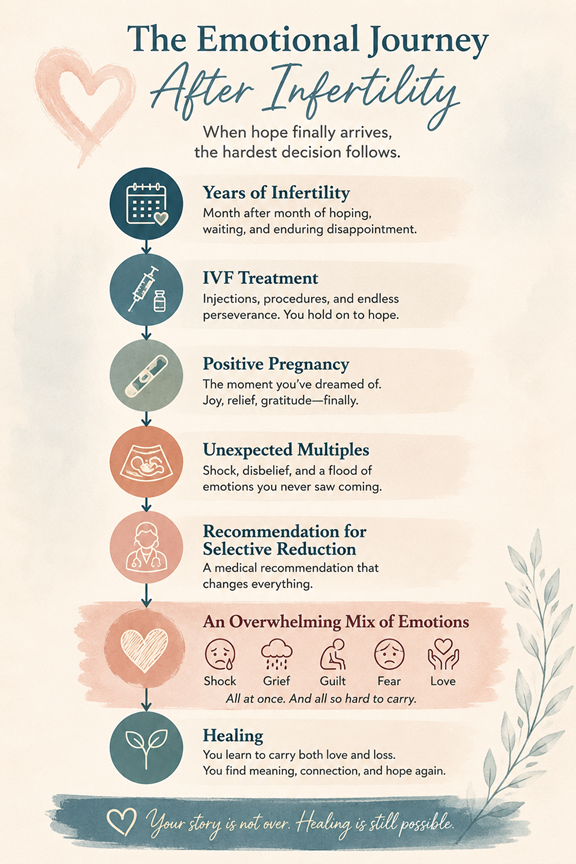
Attachment Begins Before Birth
One of the greatest misconceptions about selective reduction after infertility is the belief that attachment begins only after birth.
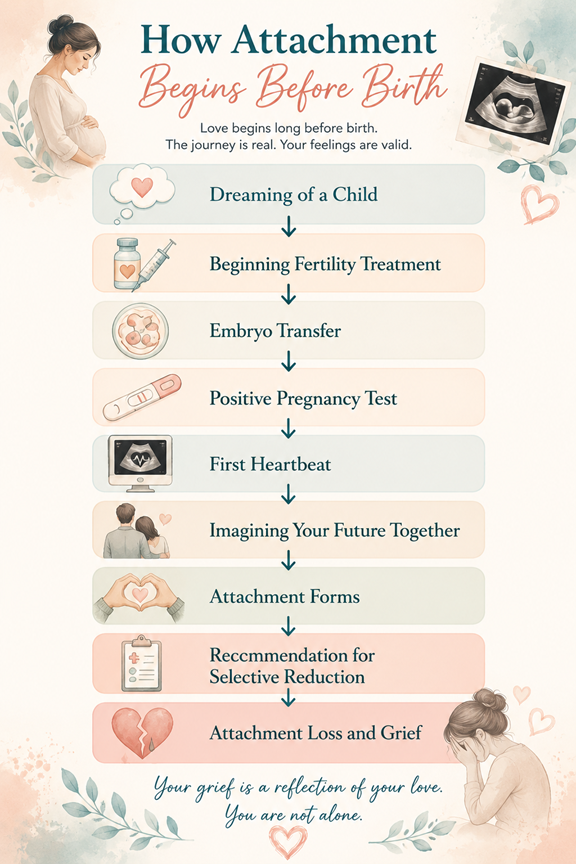
Research over the past three decades has consistently shown that emotional attachment begins long before a baby is born. It develops through anticipation, imagination, caregiving intentions, and emotional investment. For many couples experiencing infertility, that attachment begins even earlier—during fertility treatment itself.
Attachment grows through hope.
It begins during fertility consultations.
During nightly hormone injections.
During embryo transfer.
At the first positive pregnancy test.
And during the first ultrasound, when tiny flickering heartbeats appear on the screen after years of wondering whether this moment would ever come.
Long before birth, parents begin imagining an entire future.
They picture bedtime stories, family vacations, holiday traditions, first birthdays, and the sound of little feet running through the house.
They choose names.
They dream about who their children will become.
For many couples, the embryos themselves come to represent far more than the possibility of pregnancy.
They represent hope.
A future.
A family they have longed for through years of uncertainty and loss.
By the time selective reduction is discussed, these babies are no longer abstract possibilities.
They have already become part of the family’s emotional world.
Parents often tell me,
“I loved them the moment I knew they existed.”
From an attachment perspective, this is why selective reduction after infertility is experienced as far more than a medical procedure.
Parents are not grieving an idea.
They are grieving a relationship that had already begun.
This is also why comments such as “At least you’re still pregnant” or “You can focus on the babies who remain” can feel so painful. Although usually intended to comfort, these words can overlook the attachment that had already formed and the very real relationship that has been lost.
Understanding this changes the conversation.
Instead of asking,
“Why can’t I get over this?”
many parents begin asking a gentler, more compassionate question:
“How do I honor a relationship that was real, even though it was heartbreakingly brief?”
That question shifts the focus away from trying to “move on” and toward finding a way to carry both love and loss with compassion.
For many families, that is where healing begins.
How Attachment Begins Before Birth
The Grief No One Sees
After selective reduction after infertility, many parents discover that the hardest part is not only the loss itself.
It is grieving a loss that few people recognize.
Because the pregnancy continues, family and friends often focus on the babies who remain.
Medical conversations naturally emphasize improved pregnancy outcomes.
Loved ones reassure parents that they made the best decision possible.
Although these responses are usually offered with compassion, they can leave parents feeling profoundly alone.
Parents often hear comments such as:
“At least you’re still pregnant.”
“You still have your babies.”
“You made the right decision.”
What often goes unrecognized is that these parents are grieving while still carrying life.
They may feel deep gratitude for the child—or children—they are expecting while simultaneously mourning the baby they lost.
These emotions are not contradictory.
They are two expressions of the same love.
Holding joy and grief at the same time is one of the most painful—and most human—parts of this experience.
When Grief Is Accompanied by Guilt
Psychologist Kenneth Doka described disenfranchised grief as grief that is not fully recognized or validated by others. For many parents, selective reduction is exactly that kind of loss.
There may be no funeral.
No public acknowledgment.
Sometimes no one outside the couple even knows what happened.
Parents quickly discover that they are expected to move forward.
To celebrate the pregnancy.
To focus on the babies who remain.
Many want to do exactly that.
Yet they also find themselves grieving the baby who is no longer there.
Alongside grief often comes another painful emotion.
Guilt.
“Did we make the right decision?”
“Could things have turned out differently?”
“Will I ever forgive myself?”
Unlike sadness, guilt searches endlessly for certainty.
Unfortunately, certainty rarely exists.
Most parents were never choosing between a “right” decision and a “wrong” one.
They were choosing between two painful realities.
Recognizing this does not erase guilt overnight.
But it creates space for something equally important:
Self-compassion.
For some parents, guilt extends even deeper and becomes what psychologists call moral injury—the feeling that an impossible decision has challenged deeply held personal, ethical, or spiritual values. Healing moral injury rarely comes from someone saying, “You did the right thing.” More often, it begins when parents can tell their story without fear of judgment and begin treating themselves with the same compassion they would offer another loving family facing the same circumstances.
Why Partners Often Grieve Differently
One of the greatest misunderstandings after selective reduction after infertility is the belief that partners should grieve in the same way.
They rarely do.
That does not mean one partner loved more.
It does not mean one is coping better.
It simply reflects different ways of responding to overwhelming stress.
The pregnant partner often carries constant physical reminders.
Every prenatal appointment.
Every ultrasound.
Every kick.
The body becomes a reminder of both life and loss.
The non-pregnant partner often experiences grief differently.
Many describe feeling helpless.
They wanted to protect their partner.
They wanted to protect every baby.
Instead, they found themselves watching someone they love endure a painful medical procedure and emotional burden they could not take away.
Some become quieter.
Others immerse themselves in work.
Some search for information.
Others avoid talking because they fear saying the wrong thing.
From the outside, it can appear that one partner has moved forward while the other remains overwhelmed.
In reality, they are often grieving in different languages.
One grieves through tears.
The other through silence.
One remembers by talking.
The other remembers by protecting.
Neither response is more loving.
Both deserve understanding.
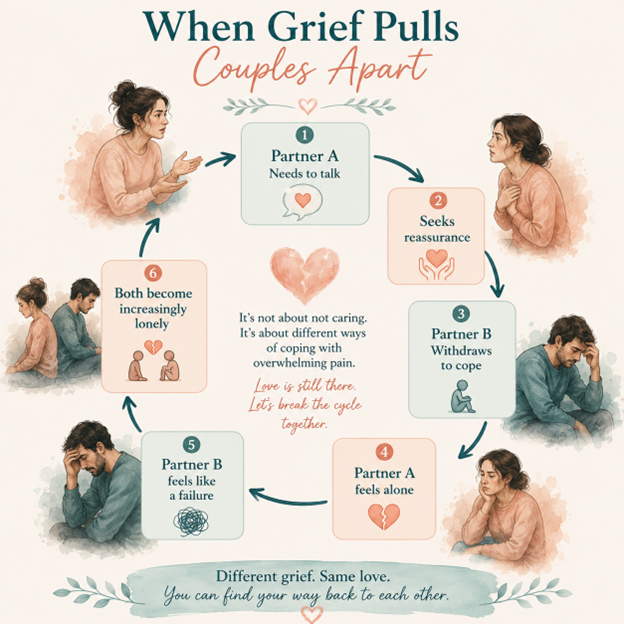
When Grief Pulls Couples Apart
One of the greatest ironies of reproductive trauma is that the people who most need one another often begin moving in opposite directions.
One partner reaches for connection.
The other withdraws to cope.
The more one pursues reassurance, the more overwhelmed the other feels.
The more one withdraws, the more abandoned the other becomes.
Eventually, both partners arrive at the same painful conclusion.
“I’m completely alone in this.”
Yet both are often thinking exactly the same thing.
This is the negative cycle described in Emotionally Focused Couples Therapy (EFT).
The problem is not either partner.
The problem is the cycle.
When Grief Pulls Couples Apart
Looking Beneath the Cycle
When couples first describe these interactions, they usually focus on behavior.
“She keeps bringing it up.”
“He never wants to talk.”
“She’s crying all the time.”
“He’s emotionally shut down.”
From an attachment perspective, those behaviors are only the surface.
Beneath them lie powerful fears.
The partner who pursues is often asking,
“Will you stay emotionally close to me while I carry this grief?”
The partner who withdraws is often asking,
“Am I failing you? Am I making your pain worse?”
Neither partner realizes that the other is asking for reassurance.
Both are trying to protect the relationship.
Ironically, those loving attempts at protection create greater emotional distance.
In nearly 30 years of working with women and couples experiencing reproductive trauma, I have found that the deepest suffering rarely comes from making the decision itself.
It comes from believing you have to carry it alone.
When couples begin responding to each other’s fear instead of reacting to each other’s behavior, something remarkable happens.
Blame softens.
Understanding grows.
The cycle slows.
Partners begin turning toward one another instead of away.
That is where healing begins.
When Grief Becomes Trauma
For some parents, selective reduction after infertility becomes more than grief.
It becomes trauma.
This is especially true when the pregnancy follows years of infertility, previous miscarriages, stillbirth, or other reproductive losses.
Some parents experience intrusive memories of the procedure.
Others become intensely anxious before medical appointments or during future pregnancies.
Some avoid reminders.
Others feel constantly on edge, waiting for another tragedy to occur.
These reactions are not signs of weakness.
They are signs that the nervous system has been overwhelmed.
Trauma is shaped not only by what happened but also by how supported—or alone—we felt while it was happening.
The encouraging news is that trauma is treatable.
With compassionate, trauma-informed care, parents can process both the grief and the fear, allowing their nervous system to gradually experience safety again.
Healing does not erase the past.
But it can change how the past lives within us.
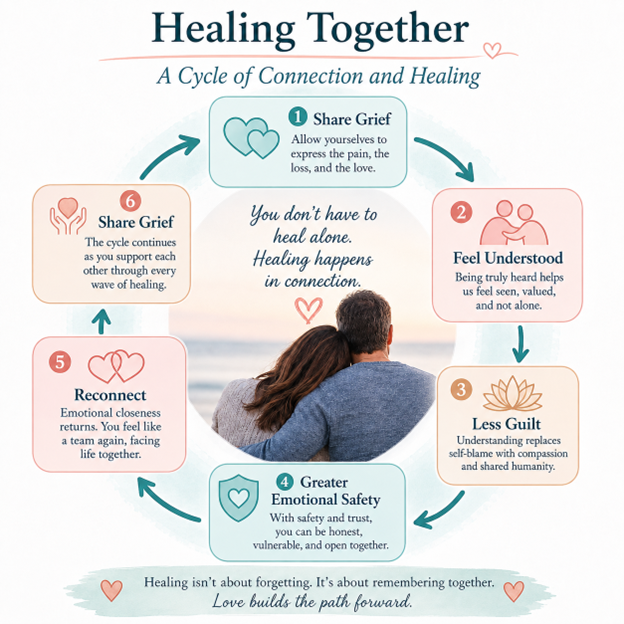
Healing Together: Finding Your Way Back to Each Other
After selective reduction after infertility, many couples ask me the same question.
“Will we ever feel like ourselves again?”
Sometimes they are asking about their relationship.
Sometimes they are asking about themselves.
Sometimes they are asking whether the grief, guilt, and anxiety will ever become less overwhelming.
The answer is yes.
Not because the loss disappears.
But because healing is possible.
Healing does not erase what happened.
It changes how you carry it.
Instead of carrying your grief alone, you begin carrying it with greater self-compassion, greater emotional support, and greater hope.
The Question That Leads Toward Healing
In the months after selective reduction, many parents become trapped by one question:
“Did we make the right decision?”
It is an understandable question.
It is also one that rarely has a satisfying answer.
Most parents were never choosing between a perfect option and a terrible one.
They were choosing between two painful realities.
Over time, a different question begins opening the door to healing.
Instead of asking,
“Did we make the right decision?”
many couples begin asking,
“How do we carry this together?”
That shift changes everything.
The first question searches for certainty.
The second creates connection.
One keeps couples looking backward.
The other allows them to move forward together.
Healing Through Connection
One of the greatest lessons of Emotionally Focused Couples Therapy (EFT) is that healing rarely happens in isolation.
When people experience reproductive trauma, they often try to protect one another.
One partner hides tears.
The other hides fear.
One stays busy.
The other becomes quiet.
Each believes they are helping.
Instead, both become increasingly alone.
Healing begins when couples stop protecting one another from their emotions and begin sharing them with one another.
Sometimes that sounds like:
“I still think about the baby every day.”
“I’ve been afraid to tell you how guilty I feel.”
“I didn’t want to make your pain worse.”
“I need to know we’re still in this together.”
These conversations are rarely easy.
But they are often the moments when partners begin finding one another again.
Three Ways to Begin Healing Together
Healing after selective reduction following infertility rarely happens through one life-changing conversation.
More often, it grows through small moments of emotional connection repeated over time.
1. Accept That You May Grieve Differently
Partners often assume they should experience grief in the same way.
Rarely do they.
One partner may cry often.
The other may become quiet.
One may need to talk.
The other may need time before finding words.
Different expressions of grief do not reflect different depths of love.
Instead of asking,
“Why aren’t you grieving like I am?”
try asking,
“Can you help me understand what this has been like for you?”
Understanding creates emotional safety.
Emotional safety creates connection.
2. Share What You Have Been Carrying Alone
Many couples unintentionally increase their loneliness by protecting one another from their deepest emotions.
Healing begins when partners become willing to say what has remained unspoken.
Perhaps it is,
“I still miss the baby every day.”
Or,
“I’ve been trying to stay strong because I thought you needed me to.”
These conversations rarely remove grief.
They do remind couples that they no longer have to carry it alone.
3. Honor the Baby While Continuing to Live Fully
Many parents worry that healing somehow means forgetting.
It does not.
Healing allows you to remember with less suffering.
Many families find comfort in creating simple rituals of remembrance.
Lighting a candle.
Planting a tree.
Writing a letter.
Speaking the baby’s name.
Others simply choose to pause together on meaningful anniversaries.
These rituals acknowledge an important truth:
Love continues.
Even when life changes.
When Professional Help Can Make a Difference
Many parents gradually find their way through grief with time, support, and open communication.
Others remain overwhelmed by guilt, anxiety, trauma symptoms, or relationship distance long after the pregnancy has ended.
Professional support may be especially helpful if you are experiencing:
- Persistent guilt or shame
- Intrusive memories or nightmares
- Anxiety during a subsequent pregnancy
- Panic before medical appointments
- Ongoing conflict with your partner
- Emotional distance or difficulty communicating
- Difficulty bonding with your baby
- Feeling emotionally stuck months or years later
As a psychologist specializing in reproductive trauma and a Certified Emotionally Focused Couples Therapist, I help women and couples process infertility, pregnancy loss, traumatic birth and the emotional impact of selective reduction after infertility.
Therapy provides a safe place to grieve openly, rebuild emotional connection, and move forward without leaving your baby—or your story—behind.
Healing Is Learning to Carry Love and Grief Together
Selective reduction after infertility may be one of the most difficult decisions parents ever face.
There are rarely perfect answers.
Only loving parents trying to make the best decision they can with the information they had at the time.
Healing is not measured by forgetting.
It is measured by your ability to carry both love and loss without allowing either to separate you from yourself, your partner, or the family you continue to build.
You may always remember the baby you lost.
That love will always be part of your story.
And it can exist alongside hope.
Alongside joy.
Alongside deep connection with the child—or children—you are raising.
Love does not end because life took an unexpected turn.
It simply changes shape.
You Don’t Have to Carry This Alone
If you are reading this because you and your partner are struggling after selective reduction after infertility, I want you to know something important:
Your grief makes sense.
The guilt.
The sadness.
The second-guessing.
The emotional distance that may have grown between you.
These are not signs that you are weak or that your relationship has failed. They are understandable responses to an experience that asked more of you than most people will ever fully understand.
For nearly 30 years, I have helped women and couples navigate infertility, pregnancy loss, reproductive trauma, traumatic birth, and the complex emotions that follow difficult reproductive decisions. As a licensed psychologist in Texas and New York, a PSYPACT provider, and a Certified Emotionally Focused Couples Therapist (EFT), I help couples move beyond isolation, guilt, and misunderstanding toward deeper emotional connection and healing.
I provide online therapy throughout Texas, New York, and all PSYPACT participating states, as well as in-person appointments in The Woodlands, serving the greater Houston area.
Whether you are grieving after selective reduction, preparing for a subsequent pregnancy, struggling with trauma symptoms, or feeling disconnected from your partner, you do not have to face this journey alone.
If this article resonated with you, I invite you to schedule a free 10-minute consultation. Email me at irena@permalink.com

References
American Society for Reproductive Medicine. (2022). Multiple gestation associated with infertility therapy: A committee opinion. Fertility and Sterility, 118(4), 575–587.
Bowlby, J. (1988). A secure base: Parent-child attachment and healthy human development. Basic Books.
Brandon, A. R., Pitts, S., Denton, W. H., Stringer, C. A., & Evans, H. M. (2009). A history of the theory of prenatal attachment. Journal of Prenatal & Perinatal Psychology & Health, 23(4), 201–222.
Condon, J. T. (1993). The assessment of antenatal emotional attachment: Development of a questionnaire instrument. British Journal of Medical Psychology, 66(2), 167–183.
Condon, J. T., & Corkindale, C. (1997). The correlates of antenatal attachment in pregnant women. British Journal of Medical Psychology, 70(4), 359–372.
Doka, K. J. (2002). Disenfranchised grief: New directions, challenges, and strategies for practice. Research Press.
Gameiro, S., Boivin, J., Peronace, L., & Verhaak, C. M. (2012). Why do patients discontinue fertility treatment? A systematic review of reasons and predictors of discontinuation in fertility treatment. Human Reproduction Update, 18(6), 652–669.
Greil, A. L., Slauson-Blevins, K., & McQuillan, J. (2010). The experience of infertility: A review of recent literature. Sociology of Health & Illness, 32(1), 140–162.
Johnson, S. M. (2008). Hold me tight: Seven conversations for a lifetime of love. Little, Brown Spark.
Johnson, S. M. (2019). Attachment theory in practice: Emotionally Focused Therapy (EFT) with individuals, couples, and families. Guilford Press.
Johnson, S. M., Makinen, J. A., & Millikin, J. W. (2001). Attachment injuries in couple relationships: A new perspective on impasses in couples therapy. Journal of Marital and Family Therapy, 27(2), 145–155.
Mao, B., & Chen, L. (2024). Pregnancy outcomes of fetal reduction from twin to singleton gestation compared with ongoing twin gestations: A systematic review and meta-analysis. Journal of Obstetrics and Gynaecology, 44(1), 2371955.
McMahon, C. A., Ungerer, J. A., Beaurepaire, J., Tennant, C., & Saunders, D. (1997). Anxiety during pregnancy and fetal attachment after in vitro fertilization conception. Human Reproduction, 12(1), 176–182.
Mitrogiannis, I., Chatzakis, C., Sotiriadis, A., Makrydimas, S., Katrachouras, A., Efthymiou, A., & Makrydimas, G. (2024). Selective fetal reduction of uncomplicated dichorionic twins on parental request versus ongoing twin pregnancies and pregnancy outcomes: A systematic review and meta-analysis. American Journal of Obstetrics & Gynecology MFM, 6(11), 101492.
Rac, M. W., Dashe, J. S., Sheffield, J. S., et al. (2021). Maternal, fetal, and neonatal outcomes of elective fetal reduction among multiple gestation pregnancies: A systematic review. Journal of Obstetrics and Gynaecology Canada, 43(12), 1455–1468.e1.
Slade, A., & Holmes, J. (2019). Attachment and therapeutic process. Routledge.
Verhaak, C. M., Smeenk, J. M. J., Evers, A. W. M., Kremer, J. A. M., Kraaimaat, F. W., & Braat, D. D. M. (2007). Women’s emotional adjustment to IVF: A systematic review of 25 years of research. Human Reproduction Update, 13(1), 27–36.
Worden, J. W. (2018). Grief counseling and grief therapy: A handbook for the mental health practitioner (5th ed.). Springer Publishing Company.
World Health Organization. (2016). WHO recommendations on antenatal care for a positive pregnancy experience. World Health Organization.
